
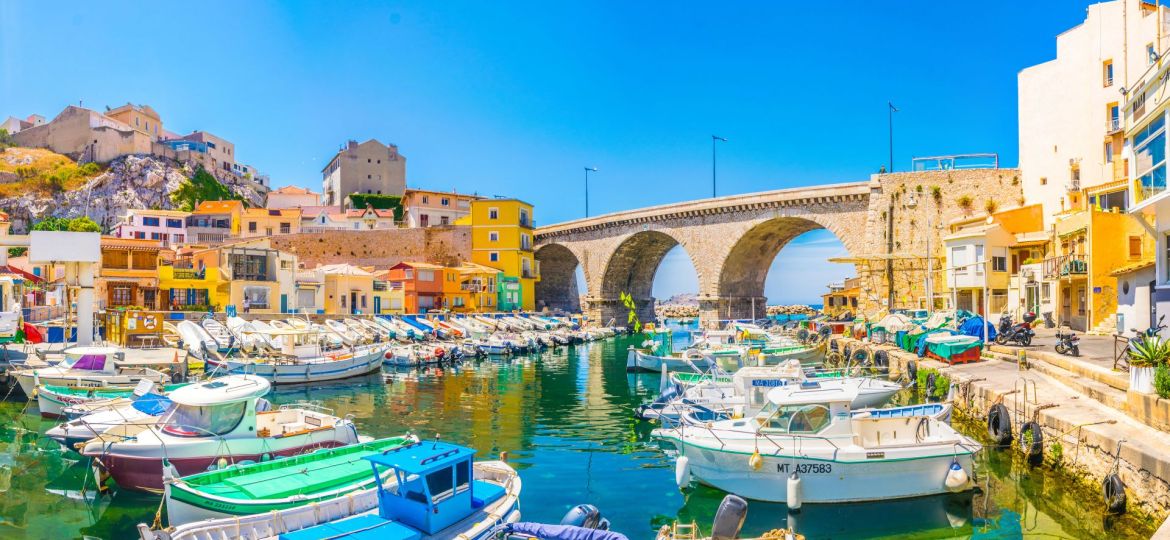
Destinations from Marseille
Ecoutez l’histoire
Lisez le script
OFFICE: Good morning.
TOURIST : This is our second time to Marseille and we would like to visit more towns and sights in the region.
OFFICE: That’s a good idea. There are a lot of beautiful coastal towns to visit. Do you have a car or do you need to use public transport?
TOURIST: We drove here from the UK.
OFFICE: Ok. there are two possibilities, you can either drive west towards Saintes-Maries-de-la-Mer or East towards Toulon.
TOURIST: Ok, can you tell us about both?
OFFICE: Certainly. If you drive west out of Marseille, you can visit Martigues where the locals like to call it the Venice of Provence. It is a colourful town with great expanses of lakeside frontage. And each July there is a Venetian Evening, with street music and theatre all over the town, climaxing in a spectacular free sound and light show over the Berre lake.
TOURIST : That sounds great!
OFFICE : Whilst you are in the area you should also visit Saintes-Maries-de-la-Mer to see the pink flamingos on the salt flats and go for a horse ride on the beach. The Camargues is a very popular destination with French visitors and foreign tourists too.
TOURIST : And what about East of Marseille?
OFFICE : You can visit the quaint town of Cassis which is not far, and spend the afternoon in the Calanques, which is a rocky stretch of coast with deep inlets where you can swim and sunbathe. It’s also possible to hire a boat with a professional sailor to take you around the inlets. This way you avoid the crowds, as it is very busy in the summer.
TOURIST : Yes we don’t like overcrowded Is there any nightlife in the area?
OFFICE: Yes there is. Just further down the coast is a town called Bandol. The village next to it is Sanary-sur-Mer where you can enjoy lively night markets and fireworks on certain nights.
TOURIST: So there are a lot of things to visit in the area!
OFFICE: yes, you have a lot of choice!
TOURIST: Oh, one last question, my husband is a former military officer and he would love to visit the military port and see some French Navy warships, can we do that ?
OFFICE: Yes, you can buy a boat tour of the harbour and it is not very expensive, it costs around 10 euros per person for an hour.
OFFICE: Thank you so much for all the information.
OFFICE: My pleasure . Have a good holiday !
Vocabulaire utile
- All over — (expression) : Partout, dans tout. « All over the place » = un peu partout. (« all over the world » déjà vu)
- Around — (préposition / adverbe) : Autour de, dans les environs, environ. Sens multiples selon le contexte. (« look around » déjà vu)
- Avoid — (verbe) : Éviter. To (avoid, avoided, avoided) — régulier. Suivi d’un verbe en -ing : « avoid going ».
- Both — (déterminant / pronom) : Les deux, l’un et l’autre. « Both of them » = tous les deux. ≠ « either » (l’un ou l’autre).
- Busy — (adjectif) : Fréquenté, animé, occupé. Contraire : « quiet ». (déjà vu épisode précédent)
- Climaxing — (verbe) : Culminant, atteignant son apogée. To (climax, climaxed, climaxed) — régulier. « Climax » = point culminant.
- Coastal towns — (nom) : Villes côtières. (déjà vu épisode précédent)
- Colourful — (adjectif) : Coloré, haut en couleur. UK « colourful » / US « colorful ». (« colourful necklaces » déjà vu)
- Crowds — (nom) : Foules. « A crowd » = une foule ; « crowded » = bondé. (« overcrowded » ci-dessous)
- Deep inlets — (nom) : Criques profondes, bras de mer. « Inlet » = petite entrée d’eau dans la côte ; « deep » = profond.
- Drove — (verbe) : Avons conduit. To (drive, drove, driven) — irrégulier. (« I’m driving » déjà vu)
- Either — (déterminant / adverbe) : Soit, l’un ou l’autre ; (en négation) non plus. « Either… or » = soit… soit. ≠ « both ».
- Expanses of — (nom) : Étendues de, vastes surfaces de. « An expanse of sand » = une étendue de sable.
- Far — (adverbe / adjectif) : Loin. Contraire : « near ». (déjà vu épisode précédent)
- Fireworks — (nom) : Feux d’artifice. Toujours au pluriel dans ce sens. « A fireworks display » = un feu d’artifice.
- Former military officer — (expression) : Ancien officier de l’armée. « Former » = ancien (qui ne l’est plus) ; ≠ « old » (âgé).
- French navy warships — (nom) : Navires de guerre de la marine française. « Navy » = marine militaire ; « warship » = navire de guerre.
- Further down — (expression) : Plus loin, plus bas. « Further » = comparatif de « far » (distance). (« go down » déjà vu)
- Harbour — (nom) : Port. UK « harbour » / US « harbor ». Proche : « port » (plus commercial/grand).
- Horse ride — (nom) : Promenade à cheval. To (ride, rode, ridden) — irrégulier. « Go for a horse ride ».
- Lakeside frontage — (nom) : Façade/front donnant sur le lac. « Lakeside » = au bord du lac ; « frontage » = façade, front.
- Lively — (adjectif) : Animé, plein de vie. Adjectif malgré la terminaison « -ly ». (déjà vu épisode précédent)
- Locals — (nom) : Habitants du coin, gens du pays. « The locals » = les gens du cru. (« local » déjà vu)
- Love — (verbe) : Adorer, aimer beaucoup. To (love, loved, loved) — régulier. « Love » + verbe en -ing (« love swimming »).
- More — (déterminant / adverbe) : Plus, davantage. Comparatif ; contraire : « less » / « fewer ».
- Next to — (préposition) : À côté de. (déjà vu épisode précédent)
- Nightlife — (nom) : Vie nocturne. Indénombrable. (déjà vu épisode précédent)
- Our — (déterminant possessif) : Notre, nos. Homophone de « hour » (heure). (déjà vu épisode précédent)
- Out of — (préposition) : Hors de, en dehors de. « Out of season » = hors saison. Contraire : « into ».
- Over — (préposition) : Au-dessus de, par-dessus, plus de. Sens multiples ; « over 100 » = plus de 100.
- Overcrowded — (adjectif) : Surpeuplé, bondé. « Over- » (trop) + « crowded » (bondé).
- Pink flamingos — (nom) : Flamants roses. « Flamingo » = flamant ; pluriel « flamingos » ou « flamingoes ».
- Professional sailor — (nom) : Marin professionnel. « Sailor » = marin ; « to sail » = naviguer.
- Quaint — (adjectif) : Pittoresque, au charme désuet. Connotation positive : joli et un peu vieillot.
- Rocky stretch of coast — (expression) : Portion de côte rocheuse. « Rocky » = rocheux ; « a stretch of » = un tronçon/une portion de.
- Salt flats — (nom) : Marais salants, salines. « Salt » (sel) + « flats » (étendues plates).
- Sights — (nom) : Sites, attractions touristiques. (déjà vu épisode précédent)
- Sound and light — (nom) : Son et lumière (spectacle). « A sound and light show » = un spectacle son et lumière.
- Street music — (nom) : Musique de rue. « Street musician » / « busker » = musicien de rue.
- Sunbathe — (verbe) : Prendre un bain de soleil, bronzer. To (sunbathe, sunbathed, sunbathed) — régulier. « Sun » + « bathe » (se baigner).
- To hire — (verbe) : Louer (un véhicule, du matériel). To (hire, hired, hired) — régulier. UK « hire a car » / US « rent a car ». Autre sens : embaucher. (« rented » déjà vu)
- Towards — (préposition) : Vers, en direction de. UK « towards » / US « toward » (sans « s »).
- UK — (nom propre) : Royaume-Uni. Sigle de « United Kingdom ». À distinguer d’« England » et « Great Britain ». (déjà vu épisode précédent)
- Whilst — (conjonction) : Pendant que, tandis que. Variante britannique et soutenue de « while ». (« while » déjà vu)
- Would — (verbe modal) : Aimerait, voudrait (conditionnel). « Would » + base verbale ; forme conditionnelle/polie. (« would like / would be » déjà vus)