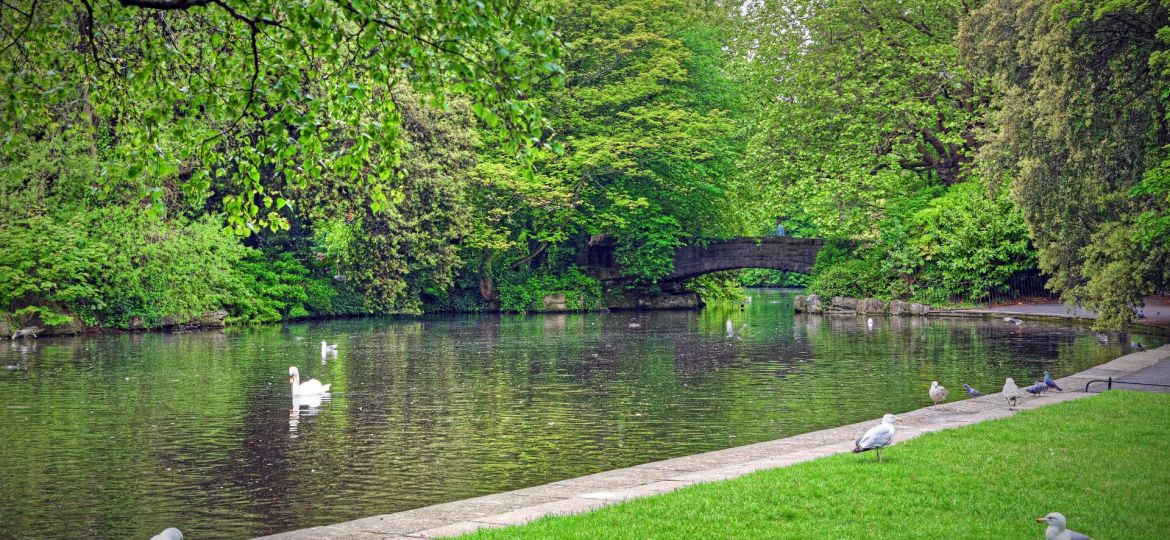
In this episode, we follow John Miller, an American tourist, and Niamh O’Connor, his Irish friend, on a rainy morning walk through St Stephen’s Green. They talk about Dublin weather, the calm of the park, and the bold ducks by the pond. Along the way they meet Fiona Gallagher, a local woman walking her dog Toby.
Characters:
- John Miller – American tourist
- Niamh O’Connor – Irish local and guide
- Fiona Gallagher – Local woman with her dog Toby
Ecoutez l’histoire
Lisez le script
Niamh: Morning, John! I wasn’t sure you’d come in this weather. Dublin rain can make people hesitate.
John: Morning Niamh! Well… I figured I should try it. You said this park is important to locals, so I wanted to see it… even if it’s raining!
Niamh: Good attitude. This is normal Dublin rain — just drizzling, not too heavy. If you stay under the trees, you’ll stay mostly dry.
John: That’s good advice. I didn’t bring anything waterproof except my jacket.
Niamh: That’s all you need. Come on, let’s walk by the pond. The paths might be a bit muddy, so watch your step!
John: Thanks. I really like the quiet here. It’s a nice break from the crowds in Temple Bar.
Niamh: Exactly. So, this is St Stephen’s Green, people come here before work to relax a bit. It’s our little break from the city noise!
Fiona: Sorry! Sorry about that! Toby gets excited when he sees new people!
John: No problem at all. He’s friendly, I can tell by the wagging tail!
Fiona: He is. He loves this park. Even though he’ll be mucky today after the rain.
Niamh: Morning, Fiona! Toby’s full of energy today. Hi Toby!
Fiona: Always. Enjoy your walk! The ducks are very bold this morning. They’ll come right up to you.
John: Bold ducks?
Niamh: You’ll see. They expect food, even though people aren’t supposed to feed them. They’ll waddle right up to your shoes!
John: Sounds like a challenge!
Niamh: It is. Right — let’s head to the little bridge! It’s a nice viewpoint, and there’s usually shelter from the rain under the branches.
John: Lead the way.
John: I like how calm it is here. The birds, the trees… it feels very different from yesterday.
Niamh: Dublin has those two sides. Busy and loud in the center, then peaceful here. When I was a student, I’d come here to unwind between classes.
John: I can see why. It feels… almost soothing.
Niamh: That’s a good word for it. Listen, hear that? That soft rustling? That’s the sound of the leaves when the rain hits them lightly.
John: It’s relaxing… even the rain feels softer here.
Niamh: That’s the magic of this park. Oh careful! That path ahead is a bit uneven.
John: Thanks for the warning. I would’ve tripped for sure.
Niamh: You’re doing grand. You’re learning the tricks of Dublin walking, rain, puddles, and unexpected slopes!
John: I’ll put that on my resume.
Niamh: Here’s the bridge. See? Lovely view of the pond. And look, there’s a duck already coming over. Bold as anything.
John: Wow, it really is bold. It’s staring at me.
Niamh: If you stand still, it’ll come even closer. But don’t give it food! The signs are clear about that.
John: No problem. I don’t want to cause duck chaos.
Niamh: Good. Also, look up a bit… the branches above us give a lot of shade in summer, and now they give a bit of shelter from the rain. Handy on days like this.
John: I like this little spot. Thanks for bringing me here.
Niamh: You’re welcome. I enjoy showing people this place.
John: I’m starting to see why.
Niamh: And you’re good company. Some visitors rush through everything, but you actually look at things.
John: Well… it helps to have a good guide.
Niamh: Hear that? That’s coming from Grafton Street where you saw the buskers yesterday. It’s close by. We can head there later to a café if you want something warm to drink.
John: I’d like that. Especially after this rain!
Niamh: Grand. Let’s finish our loop around the pond first. You’ve survived Dublin drizzle like a local… might as well complete the full walk!
John: Lead the way, Niamh.
Vocabulaire utile
- Bold — (adjectif) : Effronté, hardi. Attention au faux-ami : « bold » ne signifie pas « en gras » au sens moral ; ici c’est le sens « sans peur, culotté ». En typographie, « bold » = gras.
- Bold as anything — (expression idiomatique) : Culotté comme pas deux. Variante familière de « as bold as brass ». Très courante en anglais irlandais et britannique.
- Branches — (nom, pluriel de « branch ») : Branches. Pluriel irrégulier en -es. « Branch » signifie aussi « succursale » (a bank branch).
- Buskers — (nom) : Musiciens de rue. Du verbe « to busk » (jouer dans la rue pour de l’argent). Très employé au Royaume-Uni et en Irlande ; Grafton Street en est célèbre.
- Closer — (adjectif/adverbe comparatif de « close ») : Plus près. Ne pas confondre avec le verbe « to close » (fermer), prononcé /kləʊz/, alors que l’adjectif se prononce /kləʊs/.
- Crowds — (nom) : La foule, les foules. Souvent au pluriel en anglais là où le français emploie le singulier. Expression associée : « to draw a crowd » (attirer du monde).
- Doing grand — (expression idiomatique, irlandais) : Tu t’en sors très bien. « Grand » en Irlande signifie « bien, correct, ça va », et non « grandiose ». Réponse typique : « How are you? — I’m grand. »
- Drizzling — (verbe régulier : to drizzle, drizzled, drizzled) : Bruiner, tomber en pluie fine. Le nom « drizzle » désigne le crachin. Verbe impersonnel : « It’s drizzling. »
- Dry — (adjectif) : Sec, au sec. Contraire : « wet ». Aussi verbe régulier « to dry » (sécher). Expression : « to stay dry » (rester au sec).
- Ducks — (nom) : Canards. Aussi verbe régulier « to duck » (se baisser vivement pour éviter quelque chose).
- Feed — (verbe irrégulier : to feed, fed, fed) : Nourrir, donner à manger. Expression associée : « Do not feed the animals ». « To be fed up » = en avoir marre.
- Figured — (verbe régulier : to figure, figured, figured) : S’être dit, avoir supposé. Très fréquent à l’oral, surtout en anglais américain : « I figured I should try » = « je me suis dit que je devrais essayer ». Voir aussi « to figure out » (comprendre).
- Handy — (adjectif) : Pratique, bien utile. Synonyme : « useful ». Expression : « to come in handy » (s’avérer utile). Ne pas confondre avec « handful » (poignée).
- Head (to head there) — (verbe régulier : to head, headed, headed) : Se diriger, aller. Emploi très courant à l’oral : « Let’s head home » (rentrons). Aussi le nom « head » (tête).
- Head to — (verbe à particule) : Se diriger vers. Synonyme plus naturel que « to go to » quand on parle d’un déplacement en cours. Variante : « to head for ».
- Heavy — (adjectif) : Fort, dense (pour la pluie). Piège de traduction : avec la pluie, « heavy rain » = pluie forte, pas « pluie lourde ». Contraire ici : « light rain ».
- Lead the way — (expression idiomatique : to lead, led, led) : Ouvre la marche, passe devant. Attention à la prononciation : « lead » (mener) /liːd/ vs « lead » (plomb) /led/.
- Leaves — (nom, pluriel irrégulier de « leaf ») : Feuilles. Le -f devient -ves au pluriel (leaf → leaves), comme knife → knives. Ne pas confondre avec le verbe « leaves » (il/elle part).
- Lightly — (adverbe) : Légèrement, doucement. Formé sur l’adjectif « light ». Contraire : « heavily ». Expression : « to take something lightly » (prendre à la légère).
- Locals — (nom, souvent au pluriel) : Les habitants du coin, les gens du cru. Employé comme nom à partir de l’adjectif « local ». Expression associée : « like a local » (comme un habitant du coin).
- Look up — (verbe à particule : to look up, looked, looked) : Lever les yeux, regarder en l’air. Attention au double sens : « to look something up » = chercher une information (dans un dictionnaire, en ligne).
- Loop — (nom) : Boucle, tour. Ici : faire le tour complet d’un parc. Aussi verbe régulier « to loop ». Expression : « to be in the loop » (être tenu au courant).
- Might as well — (expression idiomatique / modal) : Autant…, tant qu’à faire. Suivi de la base verbale sans « to » : « We might as well go ». Exprime qu’il n’y a pas de meilleure option.
- Mostly — (adverbe) : En grande partie, pour l’essentiel. Nuance : « mostly dry » = presque sec, pas totalement. Synonymes : « mainly », « largely ».
- Mucky — (adjectif, familier) : Crotté, plein de boue. Registre familier britannique/irlandais, dérivé de « muck » (boue, saleté). Synonyme plus neutre : « dirty ».
- Muddy — (adjectif) : Boueux. Dérivé de « mud » (boue). Doublement du -d avant le -y. Aussi au figuré : « muddy waters » (situation confuse).
- Paths — (nom, pluriel de « path ») : Sentiers, chemins. Le pluriel change la prononciation du -th : /pɑːθ/ → /pɑːðz/. Expression : « to cross paths » (se croiser).
- Pond — (nom) : Étang, mare, bassin. Plus petit qu’un « lake ». Humour : « the Pond » désigne l’Atlantique (« across the pond » = de l’autre côté de l’Atlantique).
- Puddles — (nom) : Flaques d’eau. Ne pas confondre avec « poodle » (caniche), prononciation proche.
- Quiet — (nom / adjectif) : Le calme, le silence. Ici employé comme nom (« the quiet here »). Attention à la confusion fréquente avec « quite » (assez) — orthographe et prononciation différentes.
- Resume (US) — (nom, américain) : CV. Faux-ami majeur : le nom américain « resume/résumé » = CV, alors que le verbe « to resume » = reprendre. Équivalent britannique : « CV ».
- Right up — (locution adverbiale) : Juste à côté, jusqu’à toi. « Right » sert ici d’intensificateur de proximité : « right here », « right next to you ».
- Rush through — (verbe à particule : to rush, rushed, rushed) : Expédier, faire à toute vitesse. Sous-entend qu’on va trop vite et qu’on rate l’essentiel. Contraire : « to take one’s time ».
- Rustling — (nom / participe présent de « to rustle ») : Bruissement, froissement. Onomatopée. S’emploie pour les feuilles, le papier, le tissu.
- Shade — (nom) : Ombre (fraîcheur). À distinguer de « shadow » (l’ombre portée, la silhouette). « In the shade » = à l’ombre.
- Shelter — (nom / verbe régulier : to shelter, sheltered, sheltered) : Abri. Expression : « to take shelter » (se mettre à l’abri). « A bus shelter » = un abribus.
- Slopes — (nom) : Pentes, dénivelés. Aussi verbe régulier « to slope » (être en pente). « The slopes » désigne les pistes de ski.
- Softer — (adjectif comparatif de « soft ») : Plus doux. Contraire : « harder ». Ici au sens de doux, léger, et non « mou ».
- Soothing — (adjectif / participe de « to soothe ») : Apaisant, relaxant. Verbe régulier : soothe / soothed / soothed. Synonymes : « calming », « relaxing ».
- Stand still — (expression verbale : to stand, stood, stood) : Rester immobile, ne pas bouger. Ne pas confondre « still » adverbe (encore) et « still » adjectif (immobile). Expression : « time stood still ».
- Staring at — (verbe régulier : to stare, stared, stared) : Fixer du regard, dévisager. Toujours suivi de « at ». Plus intense que « to look at » ; peut être impoli entre personnes.
- Survived — (verbe régulier : to survive, survived, survived) : Avoir survécu à. S’emploie sans préposition : « to survive something » (et non « survive to »). Ici, usage humoristique.
- Tricks — (nom) : Astuces, trucs. Double sens : « astuce » ou « tour, farce ». Expression : « the tricks of the trade » (les ficelles du métier).
- Tripped — (verbe régulier : to trip, tripped, tripped) : Avoir trébuché. Doublement du -p. Le nom « a trip » = un voyage : deux sens très éloignés à ne pas mélanger.
- Uneven — (adjectif) : Inégal, irrégulier, accidenté. Préfixe privatif « un- » sur « even » (plat, régulier). Aussi : « uneven numbers » (nombres impairs).
- Unwind — (verbe irrégulier : to unwind, unwound, unwound) : Décompresser, se détendre. Registre familier et imagé (littéralement « se dérouler »). Synonymes : « to relax », « to chill out ».
- Viewpoint — (nom) : Point de vue, belvédère. Sens concret ici (endroit d’où l’on voit bien). Au figuré : « from my viewpoint » = de mon point de vue.
- Waddle — (verbe régulier : to waddle, waddled, waddled) : Se dandiner. Démarche typique des canards et des pingouins. Ne pas confondre avec « to wade » (patauger).
- Wagging tail — (groupe nominal : to wag, wagged, wagged) : Queue qui remue, frétillante. Expression : « the tail wagging the dog » (le monde à l’envers).
- Warm — (adjectif) : Chaud (agréablement). Nuance : entre « cool » et « hot ». Au figuré : « a warm welcome » (un accueil chaleureux).
- Waterproof — (adjectif) : Imperméable. Le suffixe « -proof » signifie « résistant à » : « soundproof », « bulletproof », « fireproof ».
- Watch your step — (expression idiomatique) : Attention où tu mets les pieds. Sens propre (attention à la marche) et figuré (fais attention à ce que tu fais). « Watch » est un verbe régulier.